- Introduction
-
Introduction
Narrator
Hello, I’m Angelica Arbelaez, Assistant Curator of Modern and Contemporary Art. Welcome to the High Museum and to Amy Sherald: American Sublime.This exhibition is the first comprehensive look at Amy Sherald’s portraiture from 2007 to 2024, and it feels especially meaningful to present it here. Sherald is a Georgia native—she studied at Clark Atlanta University—and her work has been featured at the High to great acclaim over the years. In many ways, this exhibition feels like a homecoming, and we’re excited to share it with you.
In this audio guide, you’ll hear from the artist herself, along with a range of individuals connected to the paintings and to Sherald’s practice more broadly.
- The Bathers, 2015 and Mother and Child
-
The Bathers, 2015 and Mother and Child, 2016
Rujeko Hockley:
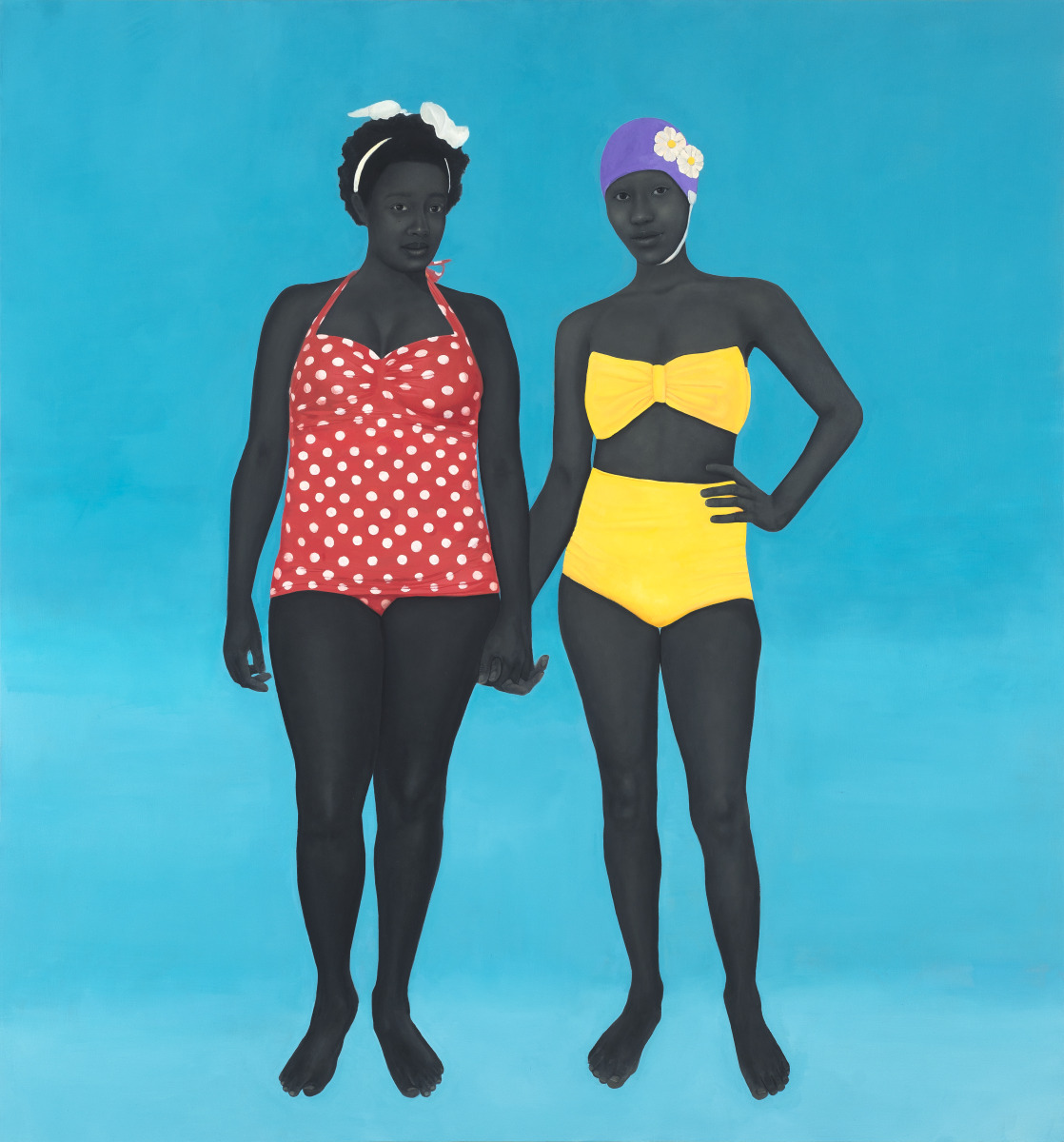
The Bathers is a painting of two young women holding hands and staring out at the viewer. In their appearance, in their dress ,and in the title of the painting, they're connected to a very long history in Western art. We see paintings by artists like Paul Cézanne, Pierre-Auguste Renoir, Titian, etc., showing images of bathers. Sherald has been thinking about this connection to art history in which we have not historically seen Black subjects portrayed in this way, and certainly also not at leisure in the way that these young women very clearly depict.Near to this painting is another painting called Mother and Child. Mother and Child, like The Bathers, is one of the most common and iconic topics of depiction in both Western art, but also going back into human history, ancient Egyptian art, ancient Greek art, cave paintings. This depiction of mother and child is uniquely human, and so again, Sherald is, here, interested in thinking about where do Black subjects fit into this arc of depiction and this arc of art history?
- Try on dreams until I find one that fits me. They all fit me.
-

Try on dreams until I find one that fits me. They all fit me.
Narrator:
Try on dreams until I find the one that fits me. They all fit me. is a vertical oil painting of a young slender person standing alone in the center gazing forward with their hands clasped wearing a bowler hat covered in flowers.Amy Sherald:
You are standing in front of a painting that is 54 inches by 43 inches. There is a single figure in the center.Narrator:
The figure wears an earthy white T-shirt tucked into blue and white pinstripe trousers with fine lines that wrinkle along the contours of their body. Though the painting crops out the figure’s legs below their thighs, a slight contrapposto pose is visible in the subtle lean of their weight to one side. At the top of the painting, the subject’s hat is topped with blooming flowers resembling pink and red peonies, a pale yellow tulip and white lily-of-the-valley. The black color of the hat gives it a magnetism like velvet. The floral arrangement is both dense and lively, creating a living composition of its own. The brim, which neatly curves upward, casts a shadow over the right side of the brow suggesting that a bright source of light is coming from the left. Although the model’s skin is rendered in greyscale, the yellow glow of the light warms the open expression of their face. While their skin tone is rendered in grey in the painting, Sherald is primarily interested in painting Black figures because of their absence in art history. The model’s eyes are peaceful, direct and assured perhaps to the point of feeling piercing, and their mouth is closed gently. The life-like scale of the painting generates a feeling of standing eye to eye with the subject.Amy Sherald:
The background is a lavender purple that looks like it would feel very soft.Narrator: This cool lavender background is patterned with faint but dark red rings like splatter from small popped bubbles.
Amy Sherald:
When I made this painting, I painted the background red first. It's a very bright fiery red. I then let it dry and I painted the purple background over top. I use oil paint, so before the paint dries, I use turpentine to drip onto the background to break up the purple colors so that the red underneath shows through. So when you look at this painting, you see the purple, but you also see little speckled parts that show this color of red underneath. - Planes, Rockets, and the Spaces in Between
-
Planes, Rockets, and the Spaces in Between, 2018
Rujeko Hockley:
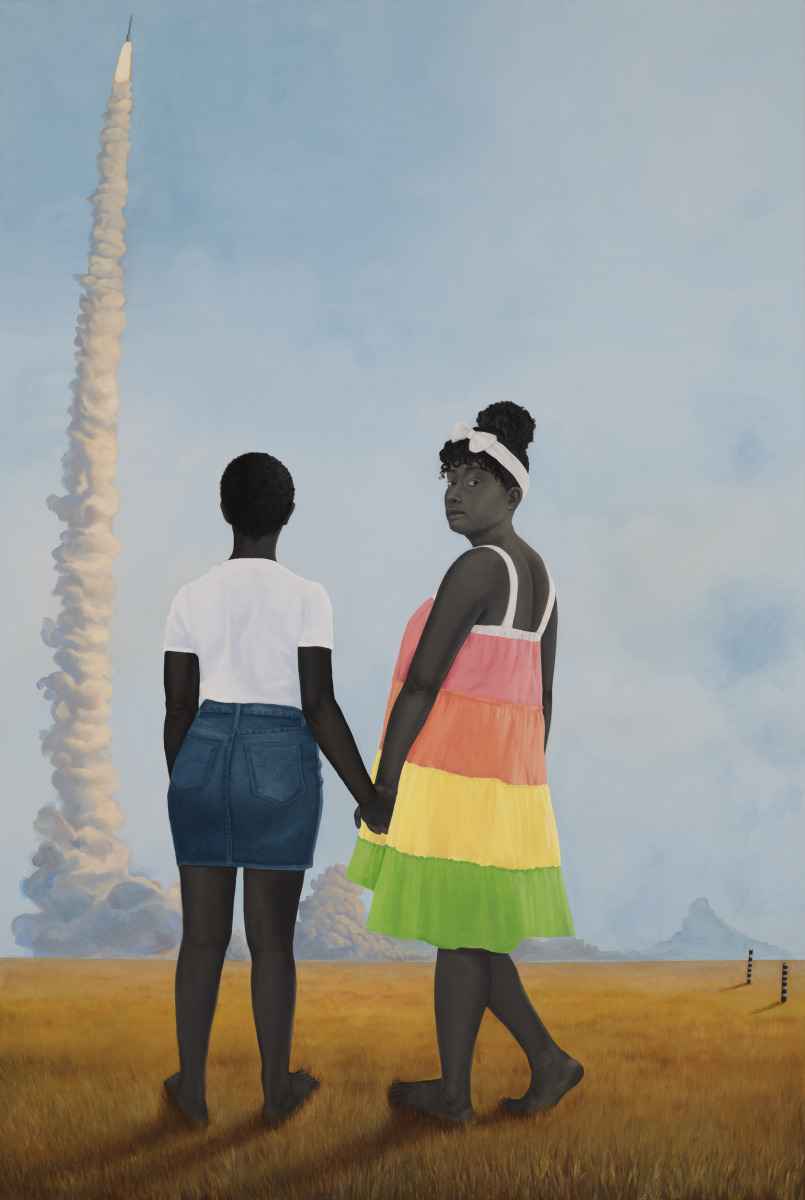
Planes, Rockets and the Spaces in Between is one of the largest canvases she had realized up to that point, and it's one of the first times where we have a very detailed and complex background and composition.Narrator:
The title may suggest that the plume of smoke on the left has been made by a rocket launch. Still, the painting invites a lot of questions.Rujeko Hockley:
There's a sense of mystery, but also a sense of wonder in the sense that a rocket taking off or kind of exploration of outer space is always this incredible thing, this unimaginable achievement of humanity. Another thing that's interesting about this painting is that the two figures, though not explicitly, do seem that they could be a couple, the two young women standing and watching this happen. One of whom has her back to us and stares out at this scene, and the other of whom turns on her foot to look back at us, to look back at the viewers. And so the idea of these Americans, these young women, these people who are possibly in a relationship with one another, bearing witness to this spectacle, to this scientific achievement, but also in this surreal, dream-like expanse and landscape is something that I think is unique to this painting. - IIf you surrendered to the air, you could ride it
-

If you surrendered to the air, you could ride it, 2019
Narrator:
Sherald came across the photograph that this painting is based off of when she was researching iconic American imagery. The 1932 photo has long symbolized American industrial ambition.Amy Sherald:
Yet, it omits the significant role Black Americans played in building this nation's greatness and its cities. My re-imagining does not dismiss the labor of the men in the original image, but instead broadens the narrative.This painting started with multiple figures that I photographed and decided that one single figure was more powerful in representing my idea than several. Through this work, I want to underscore that historical reclamation is not about replacement, it's about expansion. By isolating a single figure where there was once a collective, I shift the focus from a broad historical moment to an intimate, deeply personal reflection on Black presence within America's built environment.
The original photograph represents the grit and determination of working class immigrants, many of whom were Irish, Italian and Mohawk iron workers who built New York's skyline during the Great Depression. It celebrates their role in shaping modern America. My re-interpretation and replacement of its original construction workers with a Black figure is prompt for a deeper consideration of whose stories get told.
History is not static, but constantly shaped by the perspectives that are amplified. I think there's a way to create equality without making the rest of the room feel like they're going to just disappear and they're not being acknowledged anymore. I think there's a balance.
- Listen, You a Wonder
-

Listen, You a Wonder, You a City of a Woman, You Got a Geography of Your Own., 2016
Amy Sherald:
Listen, You a Wonder, You a City of a Woman, You Got a Geography of Your Own. The title for this painting comes from Lucille Clifton's poem, what the mirror said, which is a powerful affirmation of Black womanhood, self-worth, and embodied identity.On the summer day in Baltimore that this model showed up for this photo shoot, I had her come around 11AM because I wanted the sun to be in a particular position to capture the shadow on her face with this hat. So it added a sense of mystery along with her posture and the way she's holding the purse. And if you look at her ring finger, you'll see that the ring is not there.
I have always worked from photographs along with using images on my laptop as reference. Photography has been essential to me because it was my earliest connection to history, both personal and collective. Growing up I had only two photographs of my grandparents. Those were likely the only time they had the opportunity to take portraits in their lives. The absence of imagery shaped my relationship to portraiture because they make me deeply aware of their power to affirm presence, identity, and lineage.
- Michelle LaVaughn Robinson Obama
-

Michelle LaVaughn Robinson Obama, 2018
Michelle Obama:
Hi, there. It’s Michelle Obama.The first time I saw Amy Sherald’s beautiful portrait of me, I have to admit, it felt surreal.
It’s me through Amy’s eyes… but somehow, it’s me through my eyes, too.
I’m in this big beautiful gown. My hand is resting on my chin. And I look so thoughtful and comfortable in my skin.
The moment I saw it, I couldn’t help but think of my parents, my grandparents, and all the generations that came before me.
I thought about how hard they worked… how talented and capable they were… and how extraordinary the journey was that led our family to the White House.
It was overwhelming in the best possible way.
Because it reminded me that if Barack and I could end up as President and First Lady, that means that any kid, anywhere, could go on this journey, too.
My hope is that when people look at this painting, they see that sense of possibility staring back at them.
I hope they feel braver, stronger, and stand just a little taller.
And I hope they realize they can grow up to be anything or anyone they want to be.
That’s why I’m so grateful to Amy for the gift of this portrait, and I hope you love it just as much as I do.
- Breonna Taylor
-

Breonna Taylor, 2020
Amy Sherald:
When I painted Breonna Taylor in 2020, I wanted to honor her not just as a symbol of injustice, but as a woman who lived, loved, and was deeply loved in return. The opportunity came through Vanity Fair and Ta-Nehisi Coates, during a moment when the world was grieving and demanding accountability. I worked from photographs provided by her family, but also a well-circulated selfie that I had found on Instagram. Choosing an image that captured her quiet strength and self-assurance. The soft blue of her dress, the gentle positioning of her hands.These were choices meant to reflect the grace and dignity that should have carried her through a full life. As I painted, I found myself thinking about who she was beyond the headlines. A daughter, a partner, a dreamer. Looking back at the Black Lives Matter movement of 2020 from today's perspective, I see this portrait as both a tribute and a call to remember. The work of justice is unfinished, but memory is a powerful thing. My hope is that this painting offers a space to see Breonna fully, to hold her presence, to honor her life, and to never forget.
- A God Blessed Land (Empire of Dirt)
-

A God Blessed Land (Empire of Dirt), 2022
Denzel Mitchell, Jr.:
My name is Denzel Mitchell, Jr. I am a father, farmer, educator, cook, hip-hop head, and a friend of Amy Sherald's. I am that farmer in the painting, A God Blessed Land (Empire of Dirt). That's me.Narrator:
Mitchell is the Executive Director of the Farm Alliance of Baltimore. When asked what he sees when he looks at this painting, he said:Denzel Mitchell, Jr.:
One of the first things Amy said to me when we met years ago was that "I'm going to paint you," and this was before she was the Amy Sherald.It wasn't until we sat down to this, and I had fully developed as a farmer, a farmer owner operator who's running a business, that this is what we settled on.
We had made a very conscious choice (and I say we, my family and folks that worked on the farm) to wear overalls. And that was kind of a specific nod to the Student Nonviolent Coordinating Committee as a uniform, as a political statement, but also the utility of that. I'm actually, by happenstance, wearing overalls today, that was not by design.
Narrator:
The Student Nonviolent Coordinating Committee, or SNCC, was the student-led arm of the Civil Rights Movement.Denzel Mitchell, Jr.:
Agriculture is the basis of society. But at the same time, yes, Black people are very well aware of the fact that our labor was extracted and stolen, and was a very significant contribution to the wealth of this country. There's a lot to unpack, but it's important that Black folks stand up and be present in food production, and that all of us are present and active and engaged in shifting food production in a way that is not extractive to the earth, that is stewarding the land and creating a relationship of love with the land, because we all have to eat. - Trans Forming Liberty
-
Trans Forming Liberty, 2024
Arewà Basit:
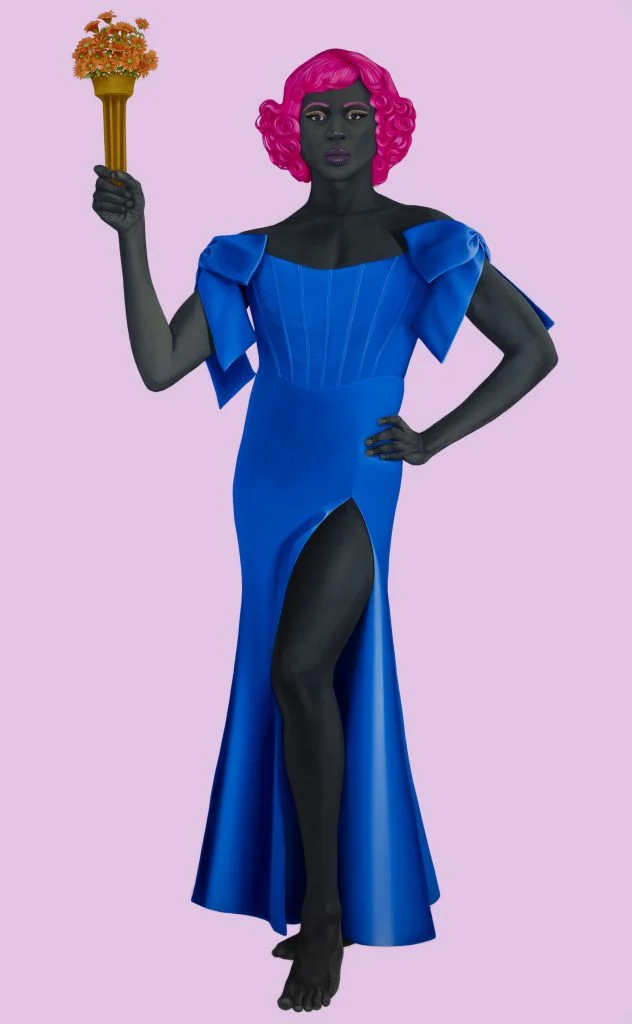
My name is Arewà Basit. I am so honored to be a muse of Amy Sherald's.When I see this, I see all of the years being told that I had to recite the Pledge of Allegiance. And when I found the truest meaning of what that pledge is, I see this version of Lady Liberty. And it's really just a lady who is empowered, empowering, and represents the fullness of what liberty and justice could give and what it can mean.
It's really, really wild, because I model. I'm a singer, I'm an artist, and so I'm very comfortable being in front of audiences and performing and to be completely honest, when I see this image, I see myself, I truly see myself, which is remarkable. What I'm seeing and feeling in this that I think excites me and makes me want to celebrate myself being perceived in this way is a pride. A full pride and acceptance of oneself.
And there are some moments where I think the world tries to tell us that being proud is a negative thing. Whether that be because of legislation, or the administration or other social systems that will try to tell me that I shouldn't be proud of who I am, I can always look back to this image and be reminded that the lack of pride will never serve me like the pride serves me.
- The girl next door
-

The girl next door, 2019
Amy Sherald:
If I think about the “girl next door” archetype, in historical paintings, we're looking for depictions of young women who appear approachable, natural, and embody an idealized version of everyday femininity.In the beginning these paintings were not made with the idea of an archetype in mind, but I realized that as I got deeper and deeper into my practice, that these figures, these portraits that I was painting were to represent something bigger, like an archetype of a kind of person that was an American.
If you're looking at this painting, The girl next door or any of the paintings in this room right now, the deliberate use of a single figure in an often dreamlike suspended space allows the subjects to exist on their own terms, unburdened by context, yet deeply present. This strategy transforms the historical function of portraiture, creating a space where Black identity is not defined by struggle or stereotype, but by quiet power, self-possession and a sense of timelessness. She is my classmate. She's my neighbor. She's the woman that owns the boutique up the street. She's every woman. Not to sound like Whitney.
- As Soft as She Is…
-

As Soft as She Is…, 2022
Candice Hoyes:
I'm Candice Hoyes and I'm a multidisciplinary vocalist and composer, and I'm the model in As Soft as She Is….When I look at this painting, I see a woman who stands out by nature, and I think it comes from this spectacular natural coat that she's wearing. I see so many qualities, emotional qualities in the colors themselves. Certainly the Black feminine divine comes through and in a way that's singular that I haven't seen anywhere else. And yet there's a ferocity and a tenderness that are twin flames in this.
The first time I got a look at the portrait, I was awash with emotion. The thing though that was intensely personal was I recognized my grandmother. I realized this gift of legacy that Amy had given me through the portrait and I just, to this day, gives me a feeling of utter wonder, like beyond words, to see the magic of the portrait work on me that way.
I'd say that I feel as a friend and an artist that Amy is devoted to the exquisite universe inside of quiet moments. The little moments between life's extremes, whether you're resting or healing or just walking into a room. And that these can be really moments that reveal so much. And she just catches these ephemeral moments that are fastballs that most can't catch. And in them are so many subtleties that tell a story of this depth below.