ExhibitionsThe Lost World: The Art of Minnie Evans
Current Exhibition

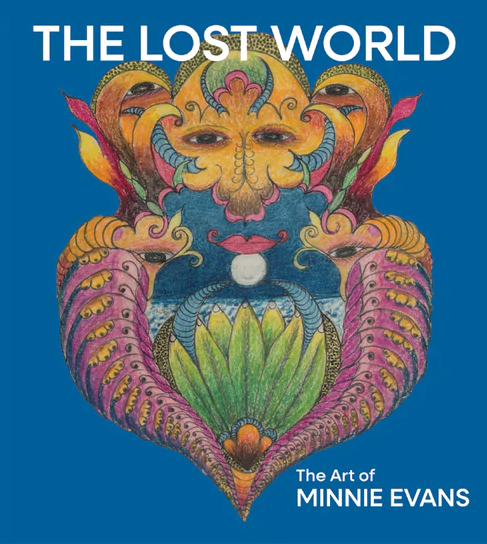
The Lost World: The Art of Minnie Evans

November 14, 2025 – April 19, 2026

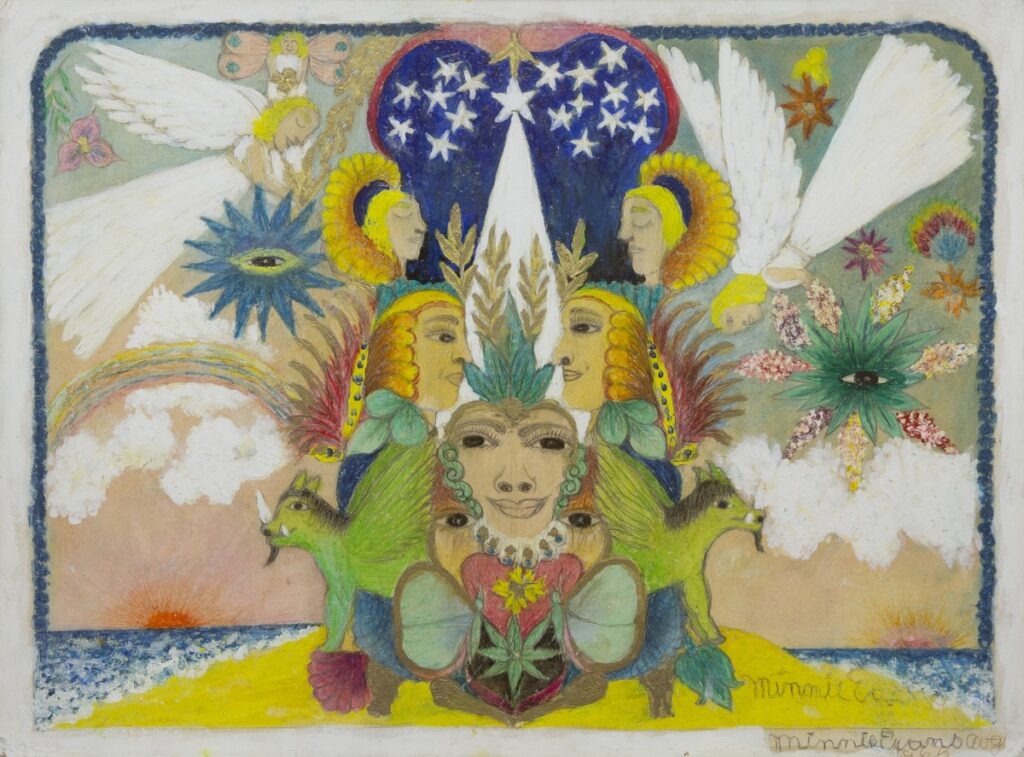
Minnie Evans once said her drawings of harmoniously intertwined human, botanical, and animal forms came from visions of “the lost world,” or nations destroyed by the Great Flood as described in the Book of Genesis. After her grandmother died in 1934 and the visions she experienced in childhood became stronger, Evans produced a large body of work ranging from abstract to representational styles. Though she found fame beyond her community in Wilmington, North Carolina—she was among the first Black artists to have a solo exhibition at the Whitney Museum of American Art in 1975—she has not been the subject of a major exhibition since the 1990s.

When Evans turned fifty-six, she shifted from decades of employment as a domestic worker to collecting admissions at Airlie Gardens, one of the most beautifully landscaped gardens in the Southeastern United States. She made art during idle moments and hung it on and near the Gardens’ exquisite wrought-iron gate. Selling or giving away her drawings to Airlie’s visitors led to a reputation beyond Wilmington and eventually a 1966 exhibition at a New York church titled The Lost World of Minnie Evans.

The High’s presentation reprises that 1966 title, honoring Evans’s interest in biblical and ancient civilizations while foregrounding the spiritual and historical circumstances of her extraordinary life. More than one hundred of her artworks are presented in a range of contexts, from the extrasensory experiences of her visions to the double-edged realities of her life in the Jim Crow South. Her drawings, beautiful and complex, thus become portals into her “lost world.”
My Very First, 1935

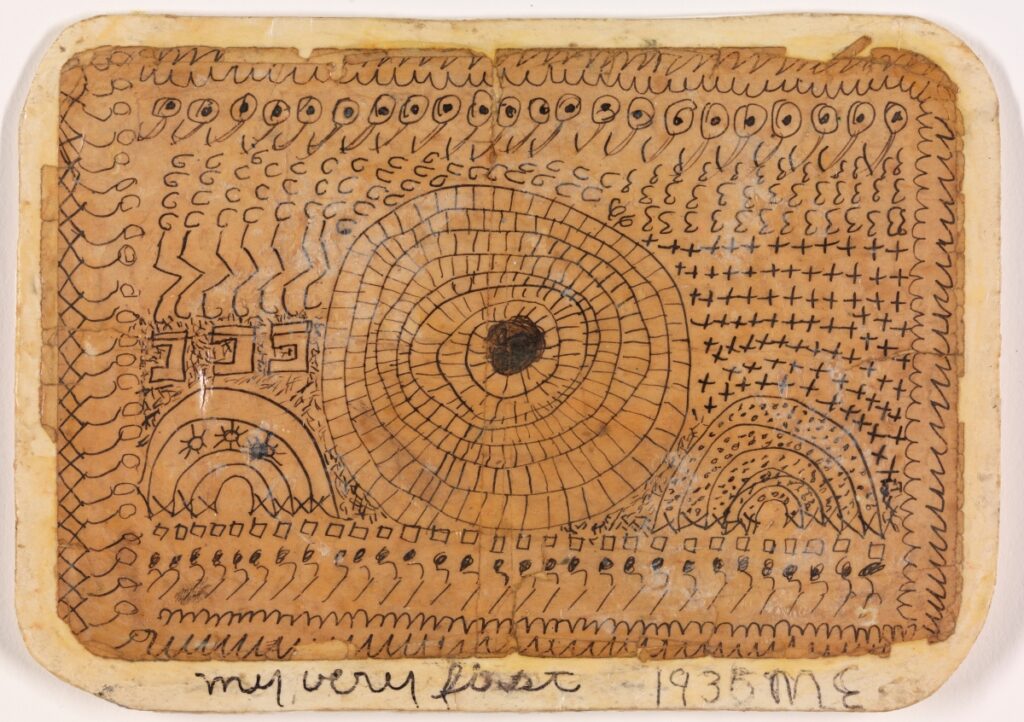
Evans began this piece after her grandmother Mary’s passing in 1934, returning to it in spring 1935. The composition’s central, layered form is a precursor to the mandalas Evans would later create. Its many tiny markings come from a process of automatic drawing that fueled the abstract designs in her early work, including glyphs she later associated with ancient writing. Evans described the process: “I had wrote my grocery order and after I tore that off then I had taken my pencil and went to making some funny things. I don’t know why but I just kept on making a lot of funny things . . .”

My Very First, 1935
Pen and ink on paper
Whitney Museum of American Art, New York, gift of Dorothea M. and Isadore Silverman

Minnie Evans, My Very First, 1935

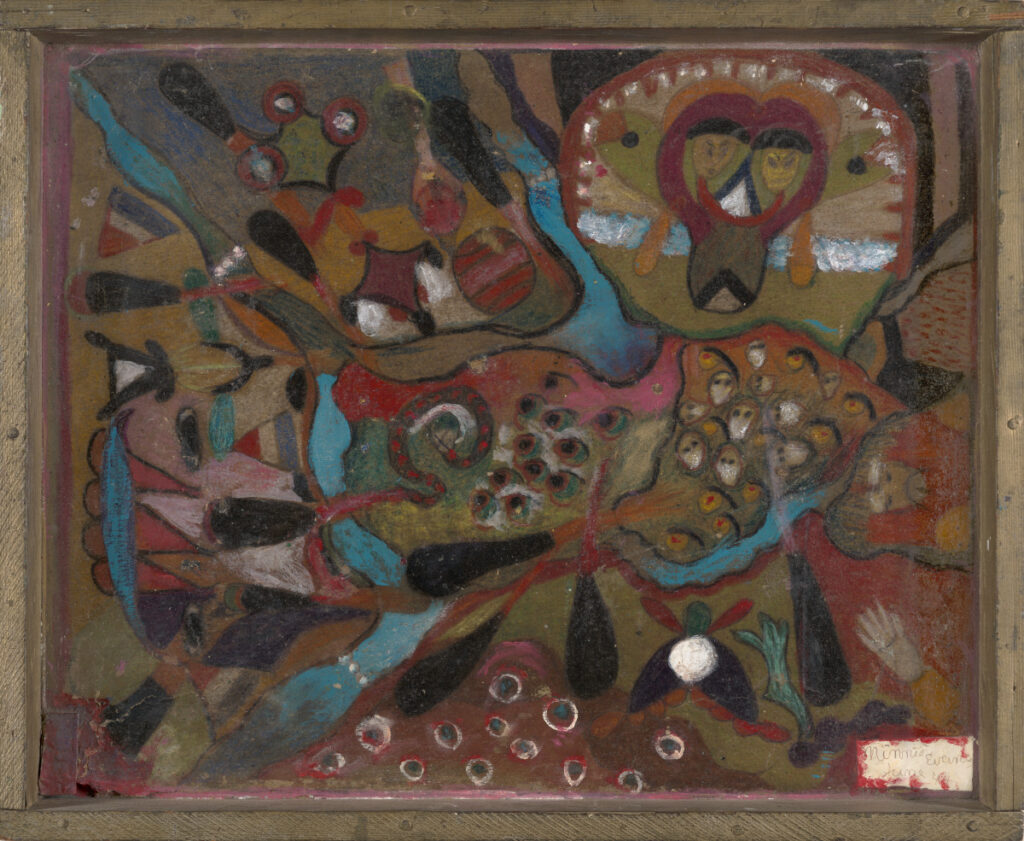
Invasion Picture, 1944

In 1944 Evans met a fortune teller named Madame Toola who had set up shop in downtown Wilmington. During a reading, Toola told Evans, “You are wrapped completely in color [and have] something of all nations.” Evans returned with several of her drawings, including Mosquito Bombs, also on view in this exhibition. In these works, Toola saw pictorial equivalents to the violent apparatus of war and insisted that Evans continue channeling her visions.

Evans responded by painting Invasion Picture. Multiple perspectives, scales, and forms collide to terrifying effect in this piece: a plane that evokes World War II combat aircraft called Mosquitoes soars from the top right quadrant of the composition toward a land mass carved by waterways that mirror Wilmington’s coastal topography. She also included a mound of skulls that seems connected to the mass deaths of the Holocaust. Days after Evans completed Invasion Picture, Allied troops stormed the beaches of Normandy, fulfilling Toola’s prophecy that, according to Evans, “the invasion in Europe is not going to happen until you paint that picture.”

Invasion Picture, 1944
Oil on composition board
The Ackland Art Museum, Ackland Fund

Minnie Evans, Invasion Picture, 1944

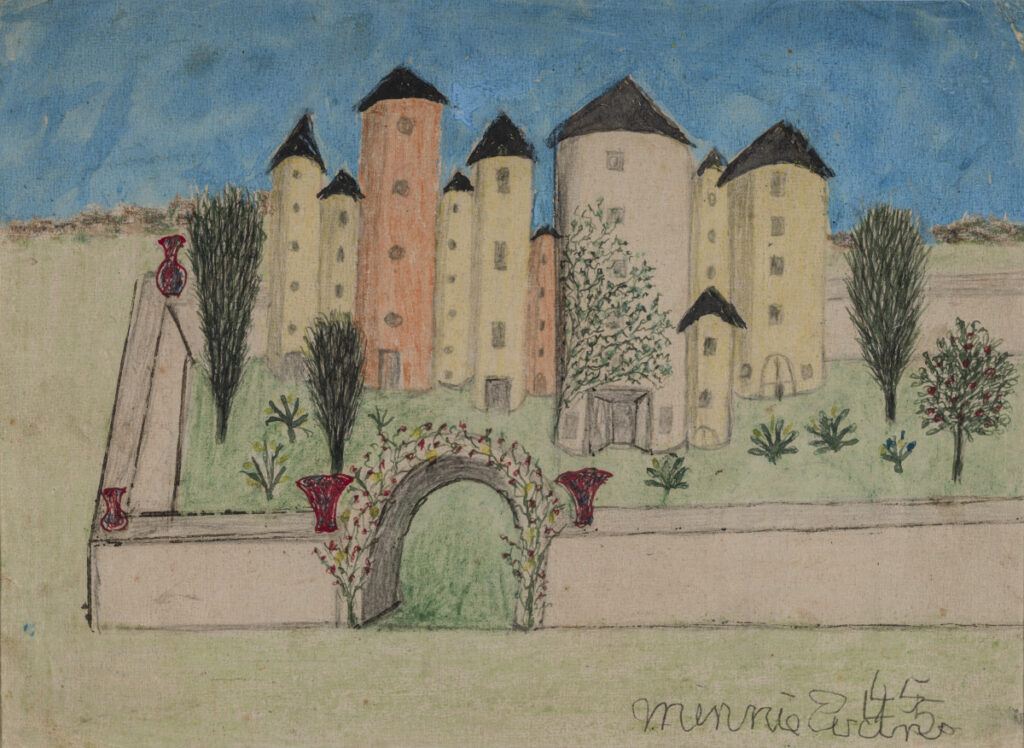
A Castle, 1945

When she was sixteen years old, Evans began living and working at the estate of Pembroke and Sarah Jones. There Evans was exposed to fine and decorative arts from around the world, which became even more sophisticated when Sarah remarried famed art collector Henry Walters. This picturesque depiction of a medieval castle could be connected to imagery Evans saw while working for the Joneses.

A Castle, 1945
Watercolor, ink, and pencil on gray United States Coast Guard paper
Collection of Nathan Kernan

Minnie Evans, A Castle, 1945

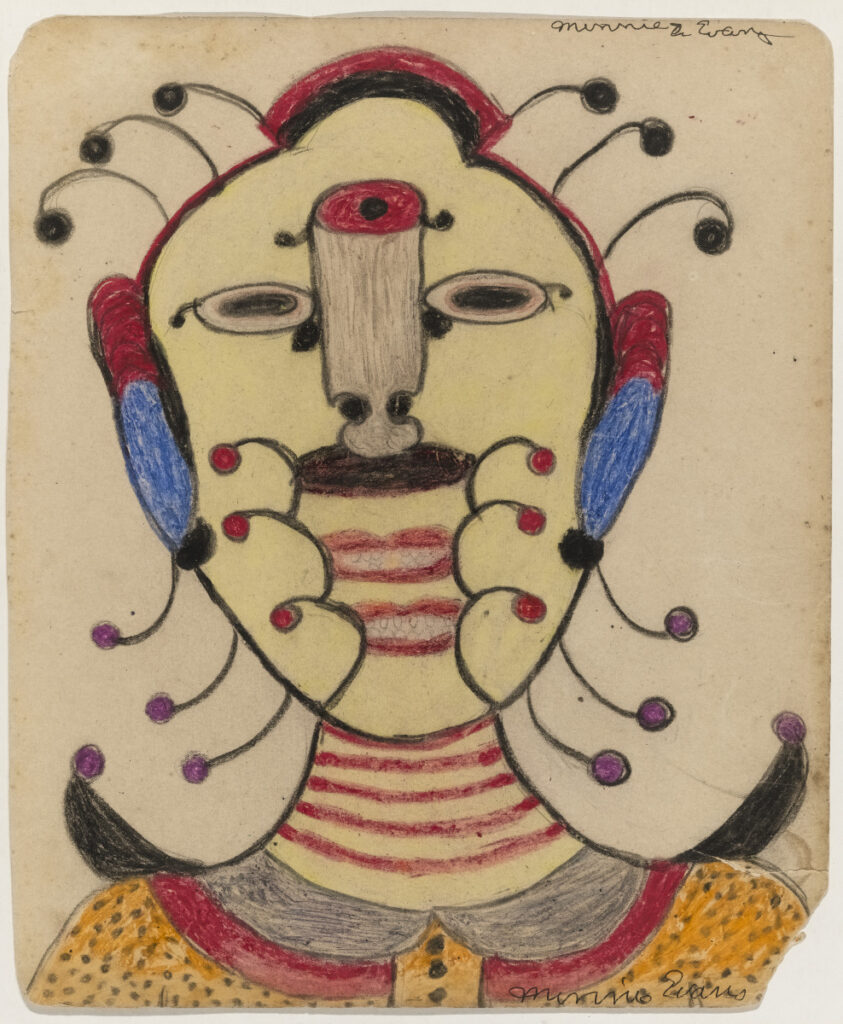
Untitled (Face with Tendrils), ca. 1944

As she added more color to her works, Evans favored Crayola crayons, which became widely available in the 1930s. This drawing of a mysterious, extraterrestrial-like form embodies the limited color palette of Evans’s early 1940s works, when wartime pigment shortages reduced the number of colors in each box. In 1958, Crayola released its sixty-four-color box with a built-in sharpener, which Evans depended on for the explosively colorful works of her mid and late career.

Untitled (Face with Tendrils), ca. 1944
Crayon and pencil on paper
Museum of Modern Art, gift of Mrs. Nina Howell Starr

Minnie Evans, Untitled (Face with Tendrils), ca. 1944

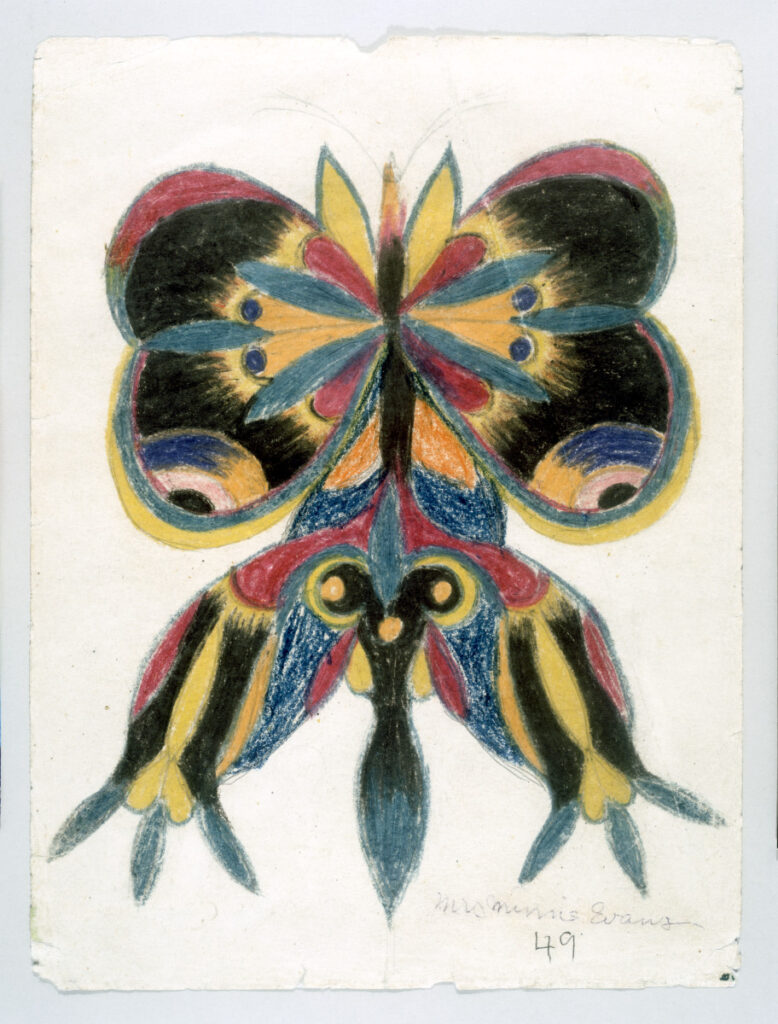
Untitled (Butterfly Form), 1949

Evans began painting the beauty of Airlie Gardens as early as the 1940s. As her drawing skills, access to materials, and proximity to the Gardens increased in the 1950s, her focus on singular floral or insectoid forms gave way in the mid-1960s to kaleidoscopic compositions exploding with radiant blooms.

Untitled (Butterfly Form), 1949
Crayon and pencil on paper
Collection of Wendy Williams, New York

Minnie Evans, Untitled (Butterfly Form), 1949

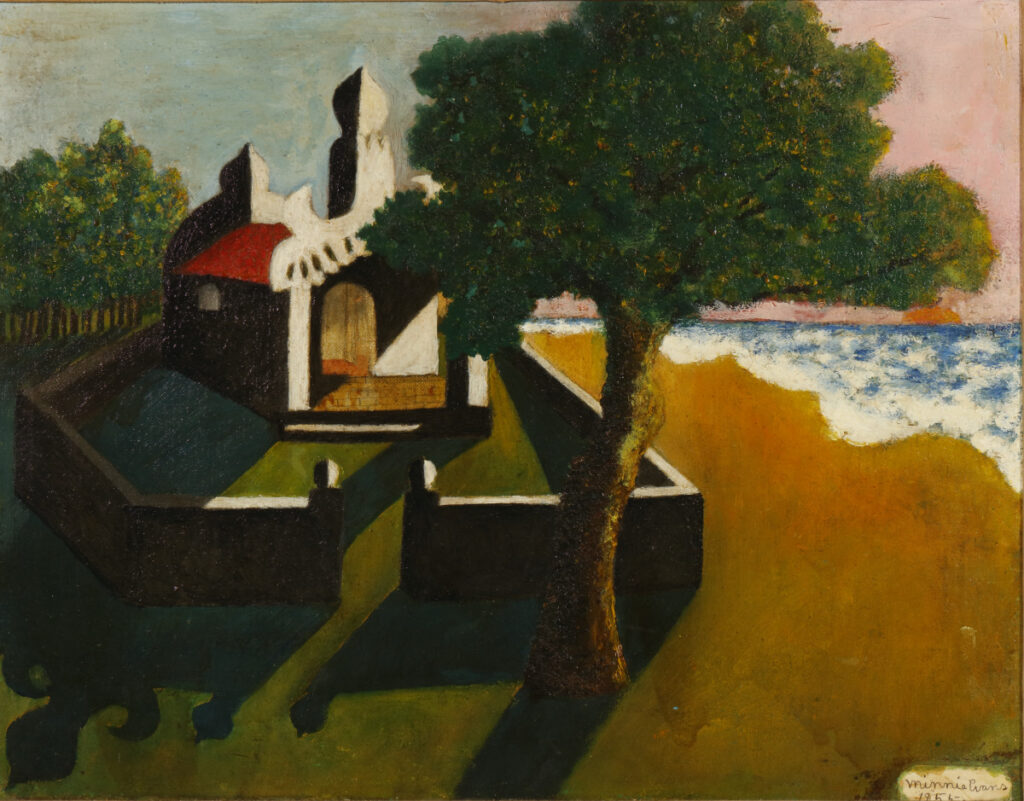
Temple by the Sea, 1955

This piece depicts a unique building resembling a coastal Hindu temple—colloquially known as Temple in the Sea—built by Sewdass Sadhu in Trinidad in 1952. That Evans placed the temple in the coastal setting she typically used for depictions of Airlie suggests that this is a self-portrait defined by place, combining where her ancestors came from and where their legacy thrived despite the many injustices that shaped their family tree.

Temple by the Sea, 1955
Oil on canvas
High Museum of Art, Atlanta, gift of the Kallir Family in memory of John Kallir, 2025.60

Minnie Evans, Temple by the Sea, 1955

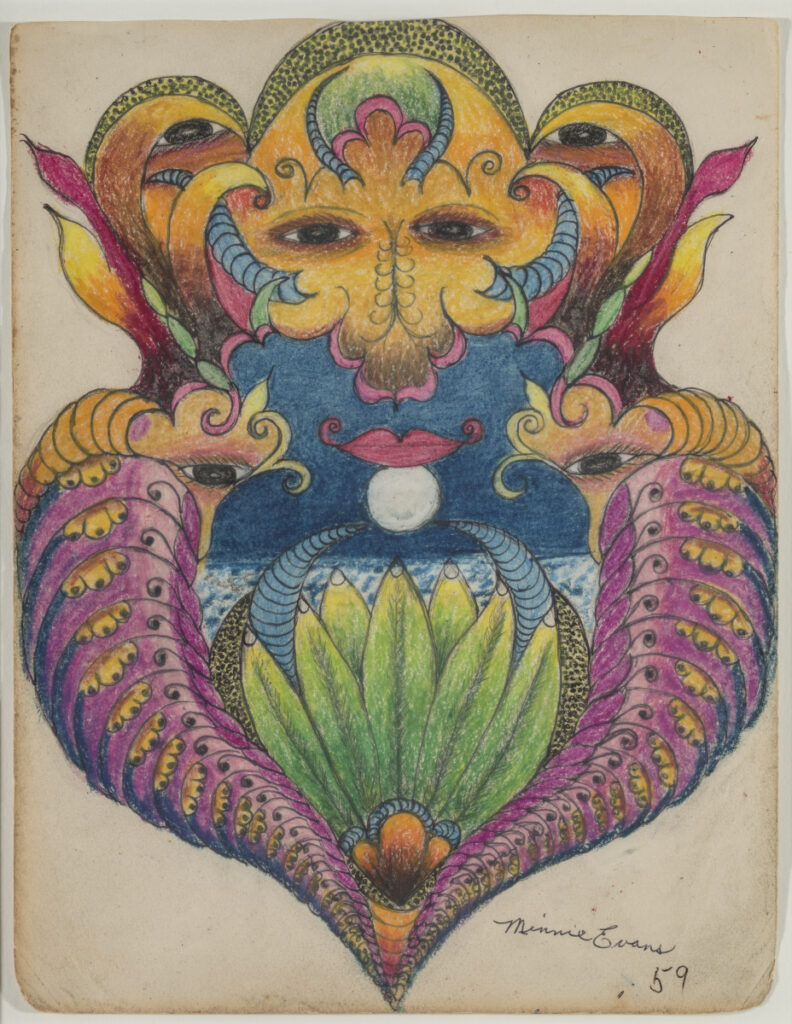
Untitled (Red Lips on Moon), 1959

In the early 1940s, Evans began experimenting with forms whose complex symmetry resonates with the tradition of Hindu and Buddhist mandalas, known for offering representations of the interconnectedness of the universe. Evans did not call them mandalas, but the connection was introduced in The Lost World of Minnie Evans (1966), the first presentation of her art in New York. Mandala drawings like this one contain forms inspired by the beauty of Airlie Gardens, as well as aesthetics related to her visions, which occurred during both sleeping and waking hours, sometimes disorienting her sense of time. During one episode that seemed to begin in the morning but included the darkening sky, she remembered exclaiming, “What is this, is this the sun eclipse?”

Untitled (Red Lips on Moon), 1959
Crayon and ink on paper
Collection of Nathan Kernan

Minnie Evans, Untitled (Red Lips on Moon), 1959

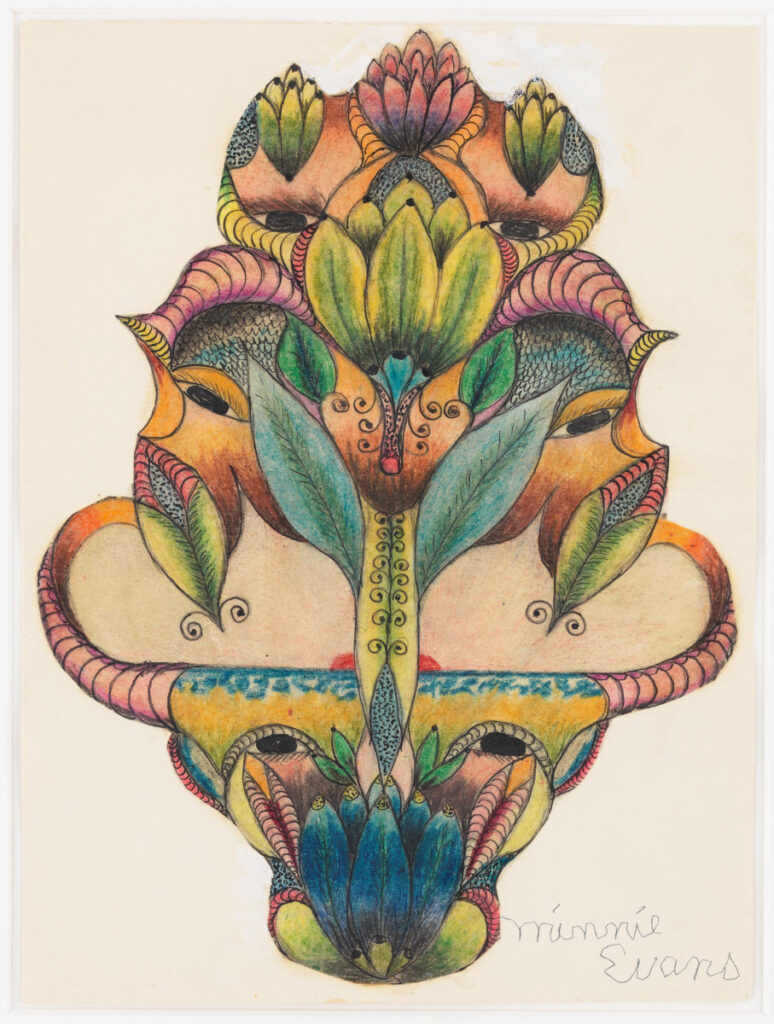
Untitled (Bull’s Head with Sunset and Eyes), ca. 1960

In some of Evans’s mandalas, segmented forms recall demonic horns or the scales of serpents and annelids, perpetuating associations with evil and malice. Perhaps the most jarring feature is the intensity of eyes: a central pair locks the viewer in a staring contest, and many mandalas contain additional eyes. Evans’s youngest son George remembers that a man once returned an artwork because the eyes kept him awake at night. Evans herself once related that she started “with the resolution to have no extra eyes, but then they work themselves in.”

Untitled (Bull’s Head with Sunset and Eyes), ca. 1960
Crayon, ink, and pencil on paper
Collection of Wendy Williams, New York

Minnie Evans, Untitled (Bull’s Head with Sunset and Eyes), ca. 1960

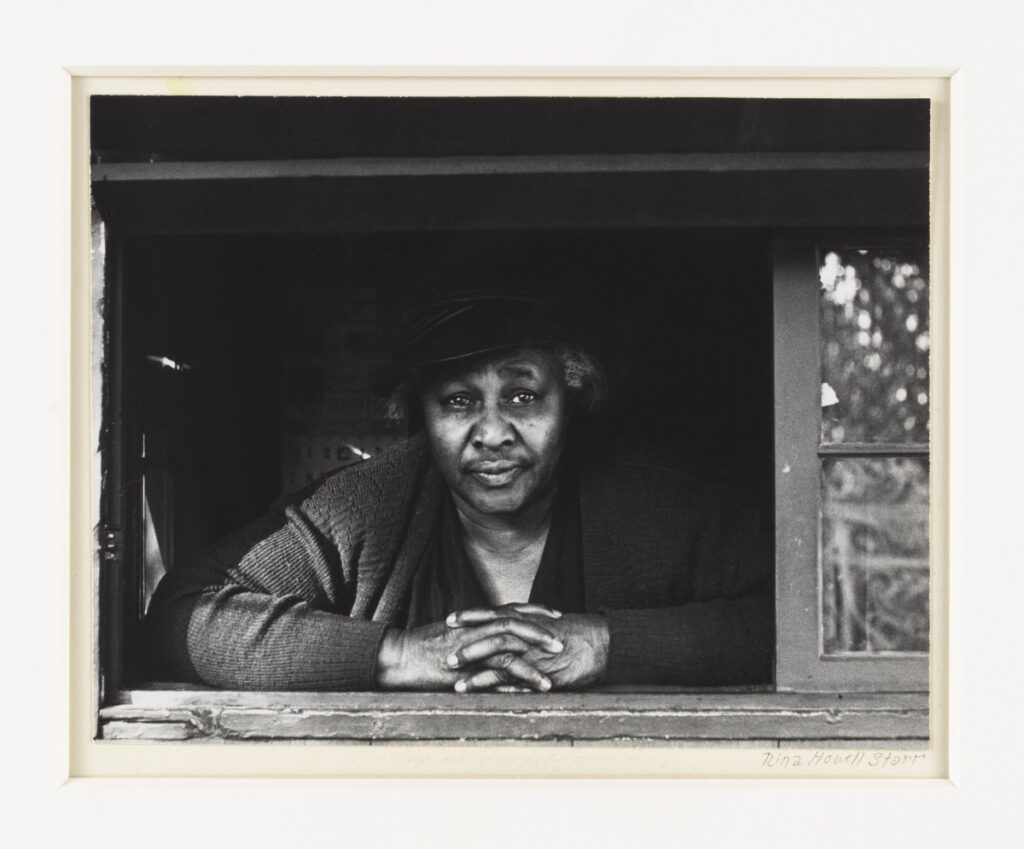
Minnie Evans in Gatehouse at Airlie Gardens, 1962

Nina Howell Starr —the photographer who would bring Evans’s work to renown in the 1960s and beyond—took this photo, her most famous portrait of Evans, at their first meeting in 1962, and she continued to photograph the artist for decades. Starr was drawn to women as subjects and took portraits of many other artists, including Consuelo Kanaga, Louise Nevelson, Georgia O’Keeffe, and Faith Ringgold, as well as women she met in her everyday life.

Nina Howell Starr
American, 1903–2000
Minnie Evans in Gatehouse at Airlie Gardens, 1962
Gelatin silver print
Collection of Nathan Kernan

Photograph of Minnie Evans in Gatehouse at Airlie Gardens

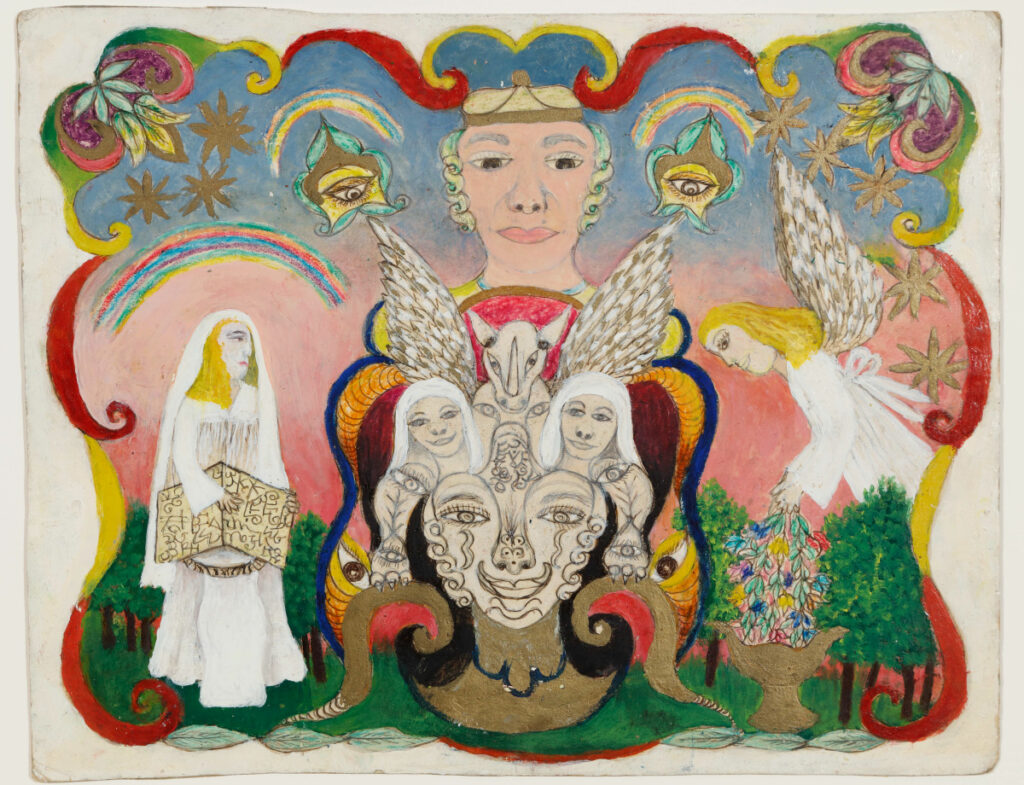
Modern Art, 1963

In 1975, Starr guest curated Evans’s solo exhibition at the Whitney Museum of American Art and wrote the following about this work, which was printed on the show’s catalogue cover:

The centrality that dominates Modern Art is topped by the full face of a person who looks in a commanding way at the startling chimerical apparition below her. [. . .] Minnie Evans often introduces the calligraphic motif which mimics ancient writing. In this picture we find it used in two ways: worked into a design with no apparent literary or literal intent, and also covering the pages of a book as though meant to be read.

Modern Art, 1963
Oil, ink, and crayon on paperboard
High Museum of Art, Atlanta, purchase with funds from Dan and Merrie Boone and the General Acquisitions Fund, 2007.90

Minnie Evans, Modern Art, 1963

Untitled (Day to Night with Beasts and Angels), 1966

Evans once said, “I would love to watch the moon and stars. I have never remembered sleeping without dreaming.” This work is defined by her interest in celestial bodies, including the sun as it would have appeared to her daily over the Atlantic Ocean. She called her mandalas that featured both the night sky and the transitioning sun her “day into night” pictures.

Untitled (Day to Night with Beasts and Angels), 1966
Crayon and pencil on paper
Collection of Christian Daniel

Minnie Evans, Untitled (Day to Night with Beasts and Angels), 1966

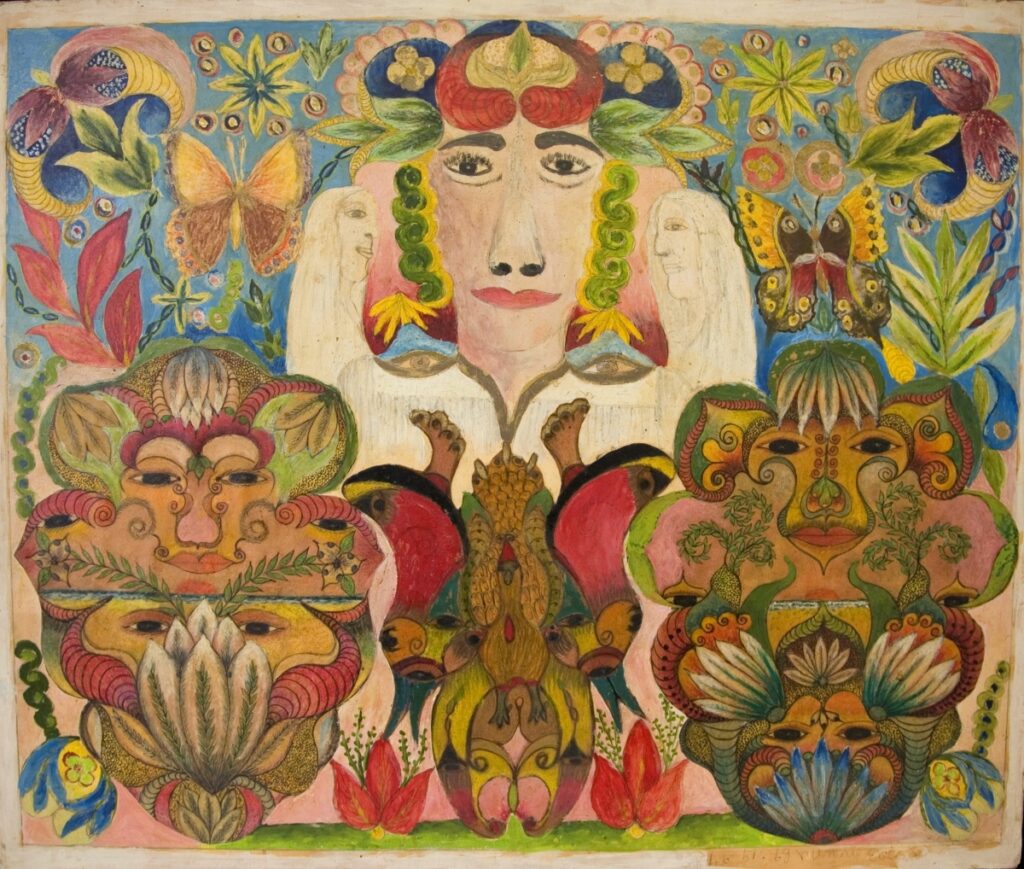
Untitled (Face Flanked by Angels and Mandalas Collage), 1946–1968

Collage was just one of the modernist art practices that Evans adopted without being aware of the breakthroughs of twentieth-century artists like Pablo Picasso or Max Ernst who are more associated with this innovation. In a review of one of Evans’s 1969 exhibitions at The Art Image Gallery, critic Barbara Rose dubbed Evans an “Unconscious Surrealist” because of how she used automatic writing and dream interpretation in her work—two practices for which Surrealists like Ernst were known. In the High’s catalogue for this show, curator María Elena Ortiz explores Evans’s relationship to Afrodiasporic surrealists who embraced the liberatory potential of dream worlds.

Untitled (Face Flanked by Angels and Mandalas Collage), 1946–1968
Pencil, ink, crayon, and oil on paperboard
High Museum of Art, Atlanta, purchase through funds provided by an anonymous donor to Collectors Evening 2011, 2011.4

Minnie Evans, Untitled (Face Flanked by Angels and Mandalas Collage), 1946–1968

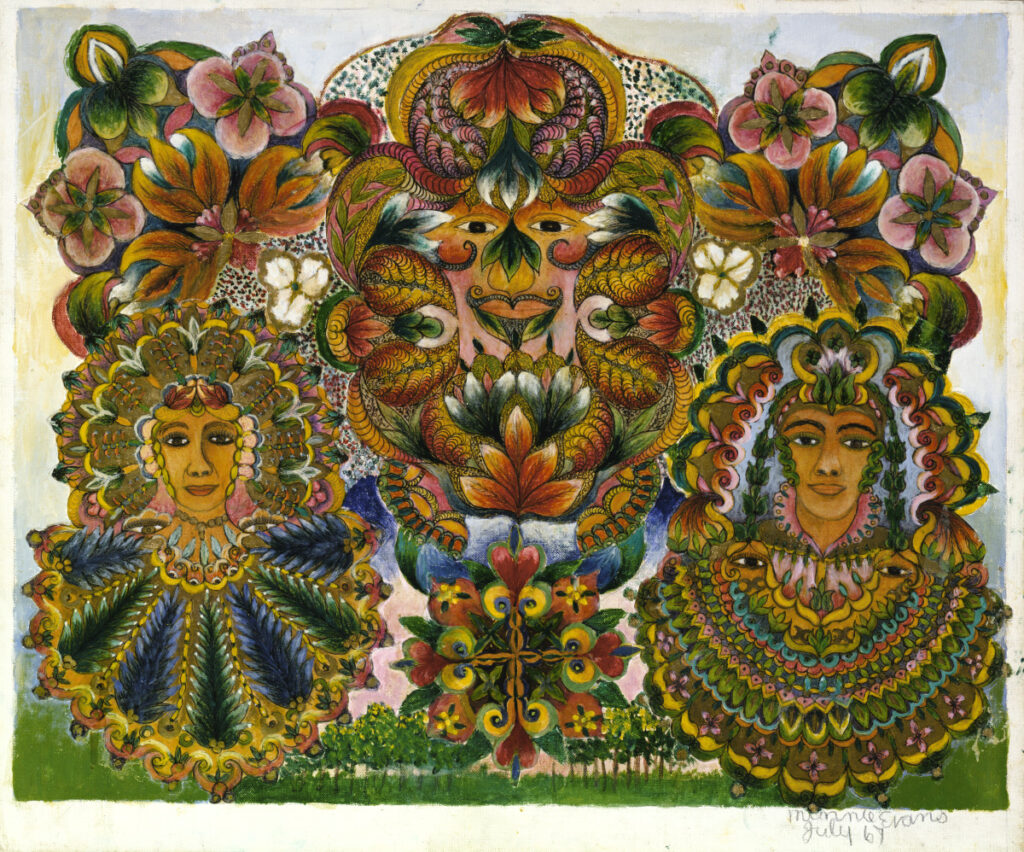
Design Made at Airlie Gardens, 1967

In many of Evans’s mandalas, including the one at the center of this composition, heads appear eerily disembodied. In others, such as the two that flank this piece, Evans composed bust portraits whose central faces rest above ornamental layers radiating into extravagant collars. These figures bear a resemblance to the costumes created for Carnival in her ancestral home of Trinidad, as well as the related tradition of Mardi Gras “Indian” costumes.

Design Made at Airlie Gardens, 1967
Oil and mixed media on canvas on paperboard
Smithsonian American Art Museum, gift of the artist

Minnie Evans, Design Made at Airlie Gardens, 1967

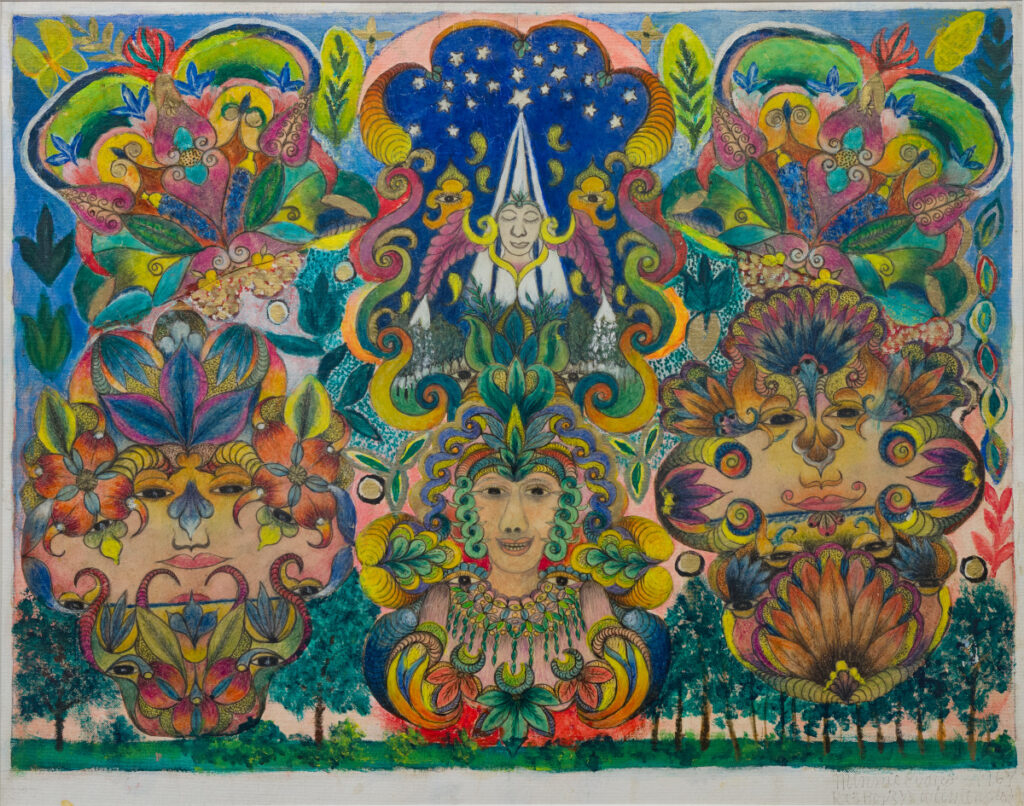
Untitled (Three Large Figures, Night Sky, and Stars Collage), 1967

Evans worked hard to maintain an element of symmetry in this collage, the largest she completed. The bright greens recall her love of nature and its seasonal cycles. “I have the blooms, and when the blooms are gone, I love to watch the green. God dressed the world in green,” she said.

Untitled (Three Large Figures, Night Sky, and Stars Collage), 1967
Oil, crayon, and pencil on paper and canvas
The John and Susan Horseman Collection, courtesy of the Horseman Foundation

Minnie Evans, Untitled (Three Large Figures, Night Sky, and Stars Collage), 1967

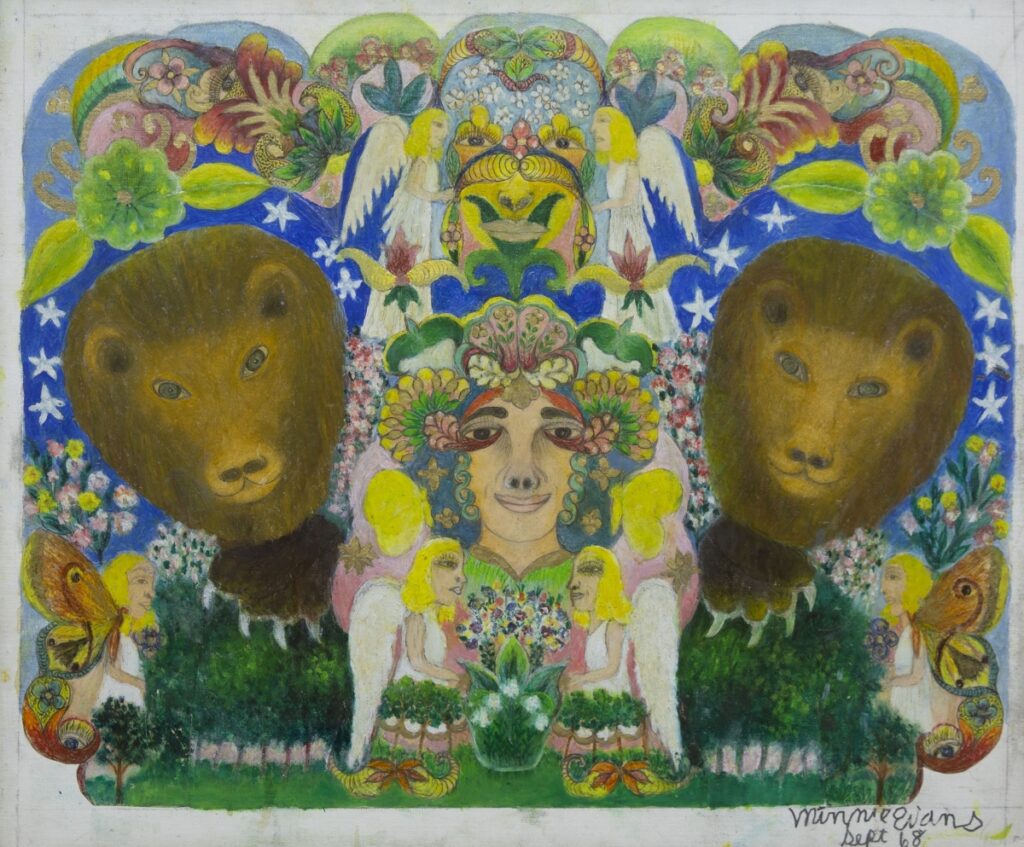
Untitled (The Lions of Judah Collage), 1968

The Lion of Judah is a reference from the Bible’s Book of Revelation and represents Jesus Christ and the redemption of humankind. In addition, Evans once shared about a dream in which she was on a parade float on New York’s Fifth Avenue pulled by a pair of lions. During her lifetime, the Lion of Judah was also closely associated with an international Black identity: for instance, the title referred to Ethiopian emperor Haile Selassie, an advocate for and symbol of Black liberation around the world.

Untitled (The Lions of Judah Collage), 1968
Oil and crayon on paper and board
Collection of Christian Daniel

Minnie Evans, Untitled (The Lions of Judah Collage), 1968

This exhibition is organized by the High Museum of Art, Atlanta.

Generous support is provided by The Dorothea and Leo Rabkin Foundation. 

Premier Exhibition Series Sponsor 

Major Exhibition Series Supporters

Sarah and Jim Kennedy

Premier Exhibition Series Supporters

Benefactor Exhibition Series Supporters

Robin and Hilton Howell

Ambassador Exhibition Series Supporters

Mrs. Harriet H. Warren

Contributing Exhibition Series Supporters 

Farideh and Al Azadi
Mary and Neil Johnson
Mr. and Mrs. Baxter Jones
Megan and Garrett Langley
Margot and Danny McCaul
Wade A. Rakes II and Nicholas Miller

Generous support is also provided by  

Alfred and Adele Davis Exhibition Endowment Fund, Anne Cox Chambers Exhibition Fund, Barbara Stewart Exhibition Fund, Dorothy Smith Hopkins Exhibition Endowment Fund, Eleanor McDonald Storza Exhibition Endowment Fund, The Fay and Barrett Howell Exhibition Fund, Forward Arts Foundation Exhibition Endowment Fund, Helen S. Lanier Endowment Fund, John H. and Wilhelmina D. Harland Exhibition Endowment Fund, Katherine Murphy Riley Special Exhibition Endowment Fund, Margaretta Taylor Exhibition Fund, RJR Nabisco Exhibition Endowment Fund, and USI Insurance Services.