
Sweeping design retrospective will feature rare and important works spanning his career, including some never exhibited
“Isamu Noguchi: ‘I am not a designer’”
April 10-Aug. 2, 2026
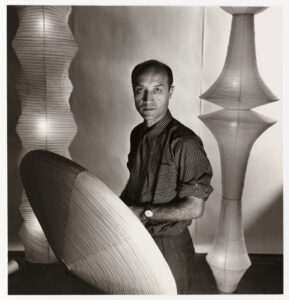
Louise Dahl-Wolfe (American, 1895–1989), “Isamu Noguchi,” 1955, gelatin silver print. © Center for Creative Photography, Arizona Board of Regents. © 2025 The Isamu Noguchi Foundation and Garden Museum, New York / Artists Rights Society (ARS), New York.
ATLANTA, Sept. 9, 2025 — Although Isamu Noguchi declared in 1949, “I am not a designer,” the internationally acclaimed artist’s work exemplifies the broadest definition of design, including sculpture, furniture, lighting, playgrounds, landscapes and theatrical sets. In spring 2026, the High Museum of Art will debut “Isamu Noguchi: ‘I am not a designer’” (April 10-Aug. 2, 2026), the artist’s first design retrospective in nearly 25 years, featuring many never exhibited and rarely seen works spanning all facets of his creative output. After the exhibition closes in Atlanta, it will travel to the Peabody Essex Museum in Salem, Massachusetts (Sept. 19, 2026-Jan. 3, 2027) and the Memorial Art Gallery of the University of Rochester in Rochester, New York (spring 2027).
Noguchi (American, 1904-1988) is widely regarded as one of the 20th century’s most accomplished and renowned artists and known for his innovative sculptures, public art and designs. Born in Los Angeles to a Japanese poet father and an American writer mother, Noguchi spent parts of his youth in both Japan and the United States, a bicultural upbringing that deeply influenced his aesthetic. Throughout his career, he deeply engaged with the role of art in public life, creating plazas, playgrounds, gardens and memorials that harmonize art, architecture and nature. His industrial and commercial designs, including famed Herman Miller furniture and “Akari” light fixtures, continue to stand out among the most well-known and celebrated in the field.
“The High has a long and unique history with Noguchi, having sponsored what became his only playground built in the United States during his lifetime: ‘Playscapes,’ which opened in 1976. Located in Atlanta’s Piedmont Park, just a few minutes’ walk from the museum, that project has been beloved by the city’s residents over the past 50 years,” said the High’s Director Rand Suffolk. “This touring exhibition is an incredible opportunity to bring so many of his rare and important works together and to share them with Atlantans, who have directly benefited from his community-oriented design for decades.”
Creating art with civic purpose was of central importance for Noguchi, who over the course of his career blended the aesthetic and utilitarian to address the social concerns of the day. This exhibition seeks to reposition his design practice, sometimes considered ancillary to his “real” work, to reinforce that it was not merely a backdrop for his sculpture. The diverse, interactive presentation will explore works that embrace function to understand Noguchi as a multinational, interdisciplinary designer who shaped a more open, inclusive world.
Co-curated by the High’s Curator of Decorative Arts and Design Monica Obniski and independent curator and sculpture scholar Marin R. Sullivan, the exhibition is grounded in an interdisciplinary approach—Noguchi’s preferred mode of working—and will feature nearly 200 objects from an international array of institutional and private lenders. Highlights include sculptural models of potential and unrealized designs, including “Play Mountain” (1933), tables designed with manufacturers including Knoll and Herman Miller, and a model of a house Noguchi designed in collaboration with architect Kazumi Adachi. The exhibition will also feature several large-scale installations, notably the spectacular stage set for choreographer Martha Graham’s very rarely performed “Seraphic Dialogue” (1955); the interactive “Play Sculpture” (ca. 1966-1976), one of Noguchi’s pieces of play equipment; and an immersive field of illuminated “Akari” paper lanterns. The exhibition’s accompanying 383-page catalogue, published by the High and edited by Obniski and Sullivan, will feature expansive, original research on Noguchi’s life and career by an international contingent of scholars and curators.
“Today we think about design as expansively as Noguchi thought about sculpture during his lifetime—or put another way, what Noguchi broadly classified as sculpture is something far closer to what we now understand as design,” said Obniski. “By exploring Noguchi’s work holistically, but intentionally from a design perspective, this exhibition offers a revisionist history that more fully accounts for the diversity of his projects and the crucial role collaboration played across this practice.”
Sullivan added, “Noguchi’s significant contributions to 20th-century sculpture have long been heralded. This exhibition, however, not only expands our understanding of how important design was to Noguchi throughout his career but also demonstrates how generative and interconnected the two disciplines were to his practice as a whole.”
Exhibition Sections
Organized thematically, the exhibition will begin with an introductory gallery featuring pivotal works that show the breadth of Noguchi’s practice:
- “Play Mountain” (1933), one of Noguchi’s foundational projects that he would refer to throughout his career, proposed the radical transformation of a New York City block into an open-ended playground for children, including an abstract landscape composed of water, a curved ramp and architectural elements. The High recently acquired the original “Play Mountain” plaster model, which has not been shown publicly since the 1930s.
- The late stone sculpture “Wounded Rock” (1981) serves as an exquisite example of how Noguchi’s designs examine the relationship between nature and art and demonstrates the temporal range of the projects in the exhibition.
The opening section, “Making Multiples,” will explore how reproducibility is central and inherent to design production yet has a more ambiguous status in the realm of “fine art.” Objects include:
- Many examples of Noguchi’s experimentation with industrial design, alongside other early design endeavors, including work for magazines like Harper’s Bazaar.
- Well-known designs, such as “Radio Nurse” (1930s), the ubiquitous Herman Miller coffee table (IN-50, designed 1944) and the Knoll-manufactured rocking stools (designed 1954-1955).
- Archival findings related to these designs, which contextualize them (and many others) within Noguchi’s broader creative practice and his work with early collaborators including R. Buckminster Fuller, Edison Price, Jeanne Reynal and Kenzō Tange.
“Elements of Architecture” follows the expansion of Noguchi’s design thinking to the scale of inhabitable interiors, his reimagination of architecture’s elemental principles, the “language” of architecture in sculpture and his many collaborations in the architectural field. Highlights include:
- Maquettes, sculptures and examples of his Lunar lighting designs, which introduce his interest in the essential elements of architecture—columns, walls and ceilings.
- Models and sketches for some of Noguchi’s architecture and design projects in Japan.
- “Architecture” he created for the stage, including the “Seraphic Dialogue” set, which has not been seen since the 1960s.
The exhibition’s last section, “Shaping Spaces,” aims to demonstrate how Noguchi’s work to build utopian spaces positively impacted their inhabitants, an aspect of these projects conspicuously absent from existing scholarship. These galleries will feature:
- A robust selection of models, drawings and visual materials that show how Noguchi operated as a shaper of social and public spaces, notably the playgrounds he began designing in the 1930s and would see come to fruition in the final decade of his career, including Atlanta’s “Playscapes.”
- Works examining how he experimented more broadly with landscape design, beginning with UNESCO’s “Jardin Japonais” (1956-1958), and civic plazas, including a decade-long redevelopment of eight acres on Detroit’s riverfront.
- A film created by the architecture studio Spirit of Space, who will capture the sights and sounds of three of Noguchi’s most important garden and public commissions to bring them to life in the galleries.
“Isamu Noguchi: ‘I am not a designer’” will be presented in the Cousins Family Special Exhibition Galleries on the Second Level of the High’s Wieland Pavilion.
Exhibition Catalogue
The exhibition is accompanied by a comprehensive 383-page catalogue edited by Obniski and Sullivan, designed by Miko McGinty Design, and distributed worldwide by Rizzoli Electa. The book features 23 texts reflecting original research by an international contingent of 17 scholars and curators, including Obniski and Sullivan in addition to Glenn Adamson, Amy Auscherman, R. Ruthie Dibble, Deborah A. Goldberg, Holly Gore, Christina Hiromi Hobbs, Matthew Kirsch, Marci Kwon, Alexandra Lange, Amy Lyford, Emily E. Mangione, Naoaki Nakamura, Sanae Nakatani, Ken Tadashi Oshima and Marc Treib.
Exhibition Organization and Support
“Isamu Noguchi: ‘I am not a designer’” is organized by the High Museum of Art, Atlanta. The Presenting Sponsor for this exhibition is Bank of America. Major funding for this exhibition is provided by the Terra Foundation for American Art, the Henry Luce Foundation and the Forward Arts Foundation. Generous support is provided by the Graham Foundation for Advanced Studies in the Fine Arts. Generous support for this publication is provided by the Wyeth Foundation for American Art. This exhibition is made possible by Premier Exhibition Series Sponsor Delta Air Lines, Inc.; Major Exhibition Series Supporters Sarah and Jim Kennedy;Premier Exhibition Series Supporters Mr. Joseph H. Boland, Jr., Harry Norman Realtors and wish Foundation; Benefactor Exhibition Series Supporters Robin and Hilton Howell; Ambassador Exhibition Series Supporter Mrs. Harriet H. Warren; and Contributing Exhibition Series Supporters Farideh and Al Azadi, Mary and Neil Johnson, Mr. and Mrs. Baxter Jones, Megan and Garrett Langley, Margot and Danny McCaul, and Wade A. Rakes II and Nicholas Miller. Generous support is also provided by Alfred and Adele Davis Exhibition Endowment Fund, Anne Cox Chambers Exhibition Fund, Barbara Stewart Exhibition Fund, Dorothy Smith Hopkins Exhibition Endowment Fund, Eleanor McDonald Storza Exhibition Endowment Fund, The Fay and Barrett Howell Exhibition Fund, Forward Arts Foundation Exhibition Endowment Fund, Helen S. Lanier Endowment Fund, John H. and Wilhelmina D. Harland Exhibition Endowment Fund, Katherine Murphy Riley Special Exhibition Endowment Fund, Margaretta Taylor Exhibition Fund, RJR Nabisco Exhibition Endowment Fund and USI Insurance Services.
About the High Museum of Art
Located in the heart of Atlanta, the High Museum of Art connects with audiences from across the Southeast and around the world through its distinguished collection, dynamic schedule of special exhibitions and engaging community-focused programs. Housed within facilities designed by Pritzker Prize-winning architects Richard Meier and Renzo Piano, the High features a collection of more than 20,000 works of art, including an extensive anthology of 19th- and 20th-century American fine and decorative arts; major holdings of photography and folk and self-taught work, especially that of artists from the American South; burgeoning collections of modern and contemporary art, including paintings, sculpture, new media and design; a growing collection of African art, with work dating from prehistory through the present; and significant holdings of European paintings and works on paper. The High is dedicated to reflecting the diversity of its communities and offering a variety of exhibitions and educational programs that engage visitors with the world of art, the lives of artists and the creative process. For more information about the High, visit www.high.org.
# # #
DIGITAL IMAGES AVAILABLE UPON REQUEST
Media contacts:
Marci Tate Davis
Senior Manager, Public Relations
404-733-4585
marci.davis@high.org
Brittany Mizell
Senior Coordinator, Public Relations
404-733-4423
brittany.mizell@high.org